
Your art, your way · Finish preview
Frame and mat preview is for illustration. Actual finish may vary slightly.
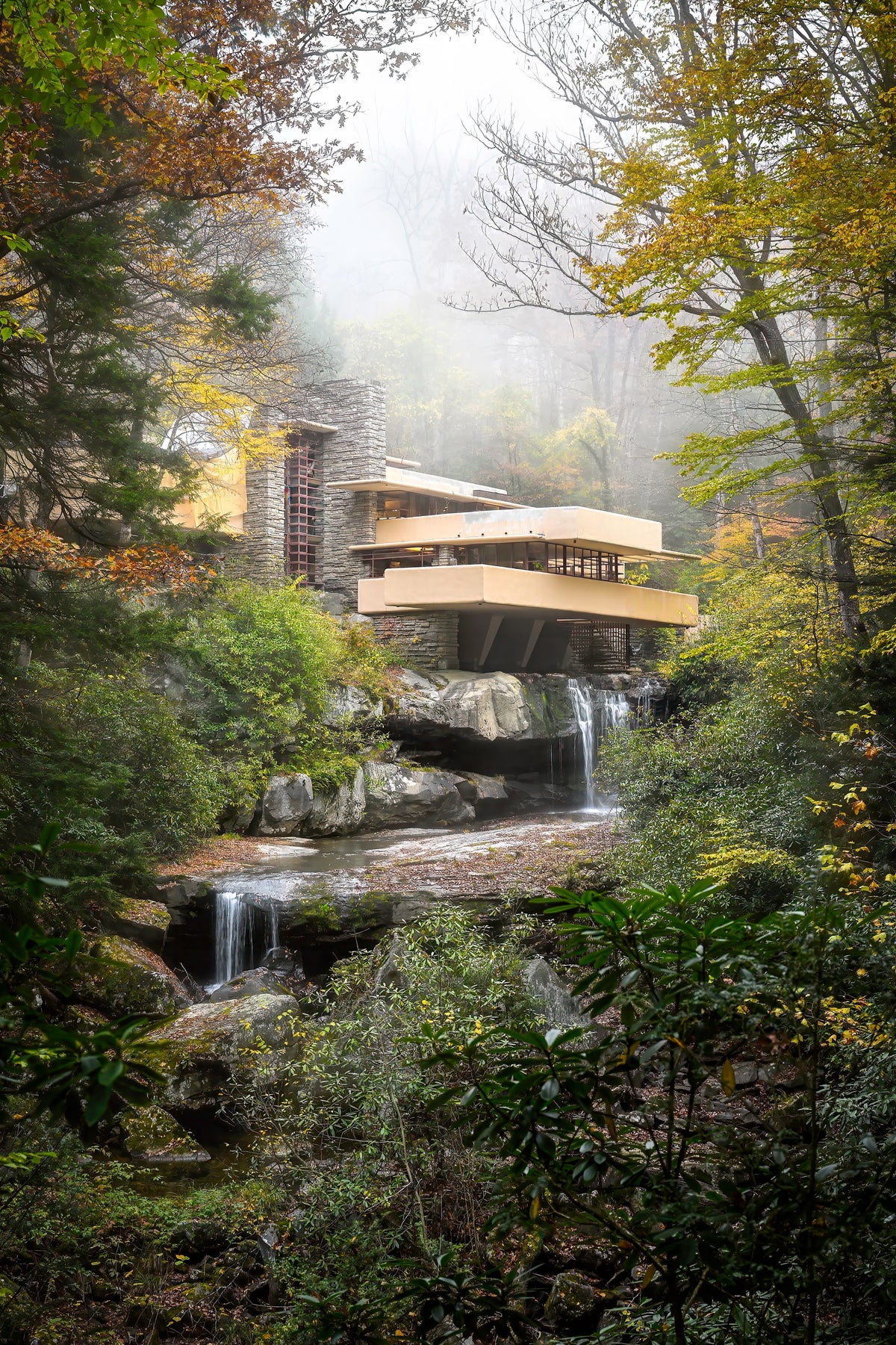
Fallingwater in the Mist
The Story Behind the Shot
I've always been fascinated by architecture, particularly when a building becomes something more than a structure and begins to feel like a natural extension of the landscape surrounding it.
Few architects understood that relationship better than Frank Lloyd Wright, and perhaps nowhere is his philosophy more beautifully realized than at Fallingwater.
Designed in 1935 as a weekend retreat for the Kaufmann family, Fallingwater is tucked into the wooded hills of southwestern Pennsylvania. Rather than positioning the house across from the waterfall, where its occupants could admire the view, Wright made the rather audacious decision to build directly above it.
He wanted the family to live with the waterfall, not simply look at it.
What a remarkable idea.
The enormous cantilevered terraces extend outward over Bear Run, seemingly suspended above the cascading water. The locally quarried sandstone walls echo the natural rock formations beneath the house, while the broad horizontal lines of the architecture complement the layered ledges of the stream.
Nearly a century later, the design still feels remarkably modern.
What drew me to this particular composition, however, was the atmosphere surrounding the house. The autumn foliage provided a beautiful mixture of gold, amber, and lingering green, while the mist drifting through the forest softened the landscape and gave the entire scene an almost ethereal quality.
I couldn't have asked for more appropriate conditions to photograph Wright's masterpiece.
As a photographer, I wanted to give the surrounding forest as much importance as the architecture itself. I chose a vertical composition, allowing the cascading water, the dense vegetation, and the mist-covered trees to frame the house naturally.
The branches reaching into the upper portion of the photograph create a wonderful sense of enclosure, while the darker foliage in the foreground draws the eye toward the illuminated terraces. The waterfalls provide a visual connection between the architecture and the landscape beneath it.
I particularly love how the mist separates the house from the forest behind it. It simplifies what might otherwise be a visually busy background, allowing the clean architectural lines to emerge gently from the surrounding woodland.
And then there's the contrast in geometry.
The forest is wonderfully irregular, filled with twisting branches, uneven rock formations, and vegetation growing wherever it finds a foothold. Wright's architecture, by comparison, is precise and deliberate, characterized by strong horizontal lines, carefully calculated proportions, and extraordinary structural ambition.
By all accounts, the two should compete with one another.
Instead, they seem entirely comfortable together.
That's what I find so compelling about Fallingwater. Wright didn't attempt to imitate nature, nor did he try to impose his architecture upon it. He found a way to create a dialogue between the two, allowing each to retain its own character while becoming part of something larger.
It's a philosophy that resonates with me as a photographer. The challenge isn't always to isolate a beautiful subject, but to understand its relationship with everything around it. Sometimes the surroundings are as important to the story as the subject itself.
Fallingwater would be a remarkable piece of architecture anywhere. But remove the forest, the sandstone ledges, and the cascading water, and something essential would be lost.
Looking at this photograph, I find myself wondering what it must have been like to spend an autumn morning inside that house. To open a window and hear the water rushing beneath you. To watch the mist drift through the trees from one of those magnificent terraces. To experience the changing seasons not as something happening outside your home, but as something you were very much a part of.
Most of us build homes to shelter ourselves from the natural world. Frank Lloyd Wright had an entirely different idea.
He built a home that invited the natural world inside.
And on this misty autumn day, I couldn't quite tell where his masterpiece ended and nature's began.
Print details
Each piece is made to order in your selected finish:
- Framed: A professional lustre photo print in a slim matte black frame with standard acrylic and a wire wall hanger. The 12×18 size has a 1.5-inch double white mat; larger sizes have a 2-inch double white mat.
- Metal: A white high-gloss metal print with a 3/4-inch float mount.
- Gallery Wrap: Premium fine-art canvas with black edges, semi-gloss protective laminate, and sawtooth hangers with backing. Standard sizes have a 1 1/2-inch depth; the 40×60 size, where offered, has a 2 1/2-inch depth.
Framed Art Dimensions
| Print Size | Finished Framed Size |
|---|---|
| 12" × 18" | 13 1/8" × 19 1/8" |
| 16" × 24" | 17 1/8" × 25 1/8" |
| 24" × 36" | 25 1/8" × 37 1/8" |
Finished dimensions include the frame and represent the overall size of the piece.
Custom Sizes & Formats
Looking for a custom size or a different finish to complement your space? I’d be happy to explore additional options with you. Simply reach out using the Send a Message link in the website footer.
Shipping & returns
Each order is custom printed and finished to your specifications and typically ships within 3–5 business days. Because every piece is made especially for you, we cannot accept returns.
If your artwork arrives damaged, please contact me so we can arrange a replacement piece.


