
Your art, your way · Finish preview
Frame and mat preview is for illustration. Actual finish may vary slightly.
The Architecture of Eternity
The Story Behind the Shot
Standing at the edge of the Grand Canyon, I find myself struggling to comprehend two things: the extraordinary scale of the landscape before me and the almost unimaginable amount of time it took to create it.
Neither is particularly easy to capture with a camera.
The Grand Canyon is an enormous geological canvas, revealing nearly two billion years of Earth's history within its exposed rock. Ancient seas, vast deserts, and environments that disappeared hundreds of millions of years ago have left their signatures in the sandstone, limestone, and shale that form these magnificent cliffs.
And the Colorado River, assisted by weather and erosion, has spent millions of years exposing them for us to see.
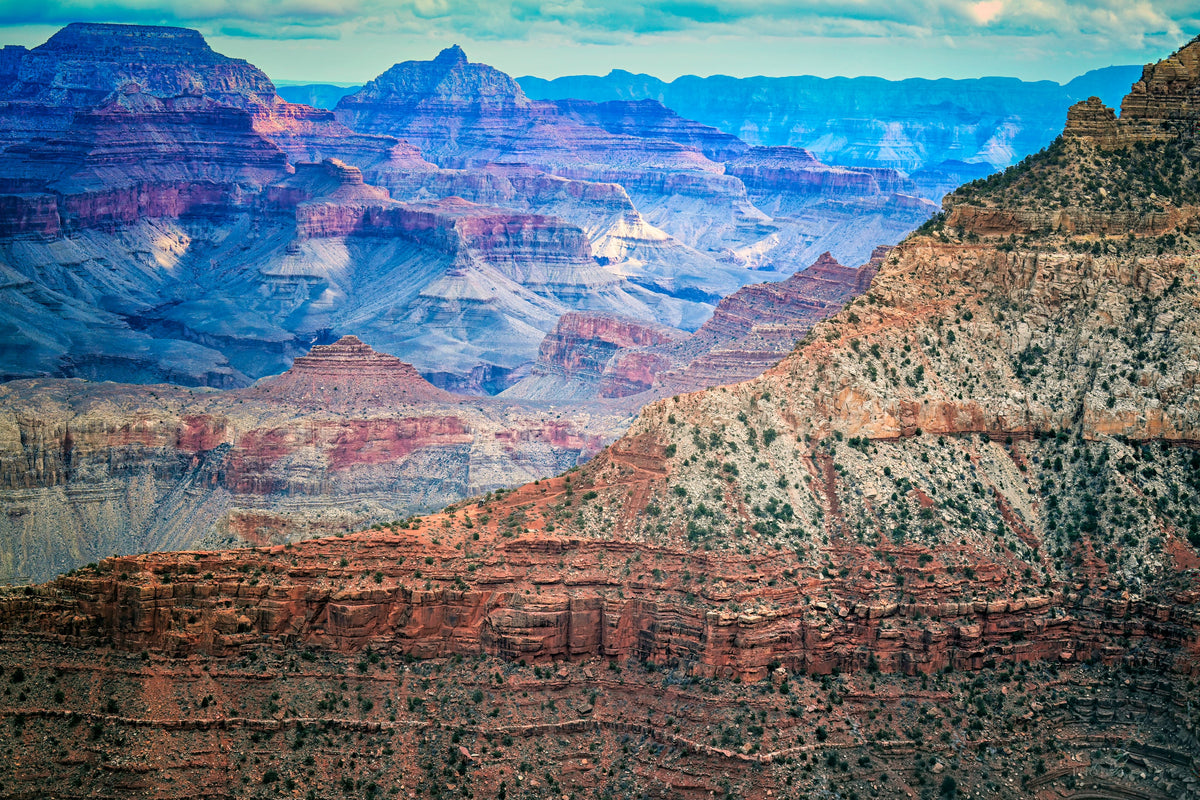
What fascinates me about this particular photograph is the extraordinary architecture of the canyon. Enormous terraced formations rise from the depths, their horizontal layers interrupted by steep ravines, towering buttes, and deeply carved valleys. Some resemble ancient pyramids, others great temples or the remnants of a civilization that never existed.
Nature has quite an imagination.
As a photographer, I wanted to move beyond the traditional panoramic view of the Grand Canyon and concentrate instead on the relationship between these individual formations. I kept the sky to a minimum, allowing the intricate geology to dominate the composition.
The massive ridge in the foreground sweeps diagonally across the photograph, providing a natural sense of depth and drawing the eye toward the seemingly endless succession of formations beyond it.
What I particularly love is the transition in color.
The rich, earthy reds and warm sandstone tones of the foreground gradually surrender to lavender, violet, and magnificent shades of blue in the distance. Atmospheric haze softens the more remote formations, separating the landscape into distinct visual layers and giving the photograph an almost painterly quality.
And then there's the wonderful influence of the clouds.
Pockets of sunlight illuminate individual sections of the canyon while leaving others in deep shadow. The effect is almost theatrical, as though someone were moving an enormous spotlight across the landscape, revealing different geological formations one at a time.
This is precisely why I love photographing landscapes beneath a cloud-filled sky. The Grand Canyon doesn't physically change from one minute to the next, but the light can completely reinvent it.
I could photograph this same composition a dozen times throughout the day and come away with a dozen remarkably different images.
Beyond the photography, however, I find the science behind this landscape absolutely fascinating.
Some of these layers were deposited when this part of Arizona lay beneath ancient oceans. Others formed from enormous fields of sand dunes. Over immense stretches of geological time, sediments accumulated, hardened into rock, and were eventually uplifted before erosion began revealing the extraordinary landscape we see today.
Imagine the number of worlds that have existed here.
Oceans have come and gone. Entire ecosystems have appeared and disappeared. Continents have shifted, mountains have risen, and countless species have evolved and become extinct.
All of that history, compressed into layers of stone.
I've always enjoyed photography that encourages us to think beyond what we can immediately see. This image does that for me. The longer I look at it, the less I see simply a beautiful canyon and the more I see an extraordinary record of a planet that has been reinventing itself for billions of years.
We measure the age of our greatest architectural achievements in centuries. Here, the architect worked on an entirely different scale, using oceans, rivers, gravity, and time as its tools.
There were no blueprints, no deadlines, and no one waiting to admire the finished work.
And perhaps the most remarkable thing of all is that the masterpiece still isn't finished.
Print details
Each piece is made to order in your selected finish:
- Framed: A professional lustre photo print in a slim matte black frame with standard acrylic and a wire wall hanger. The 12×18 size has a 1.5-inch double white mat; larger sizes have a 2-inch double white mat.
- Metal: A white high-gloss metal print with a 3/4-inch float mount.
- Gallery Wrap: Premium fine-art canvas with black edges, semi-gloss protective laminate, and sawtooth hangers with backing. Standard sizes have a 1 1/2-inch depth; the 40×60 size, where offered, has a 2 1/2-inch depth.
Framed Art Dimensions
| Print Size | Finished Framed Size |
|---|---|
| 12" × 18" | 13 1/8" × 19 1/8" |
| 16" × 24" | 17 1/8" × 25 1/8" |
| 24" × 36" | 25 1/8" × 37 1/8" |
Finished dimensions include the frame and represent the overall size of the piece.
Custom Sizes & Formats
Looking for a custom size or a different finish to complement your space? I’d be happy to explore additional options with you. Simply reach out using the Send a Message link in the website footer.
Shipping & returns
Each order is custom printed and finished to your specifications and typically ships within 3–5 business days. Because every piece is made especially for you, we cannot accept returns.
If your artwork arrives damaged, please contact me so we can arrange a replacement piece.


