Your art, your way · Finish preview
Frame and mat preview is for illustration. Actual finish may vary slightly.
The Geometry of Light
The Story Behind the Shot
New York City is an absolute playground for anyone who enjoys architectural photography. From the magnificent Beaux-Arts grandeur of Grand Central Terminal to the intricate steel cables of the Brooklyn Bridge, the city offers an extraordinary collection of architectural styles spanning generations.
And then there's the Oculus.
Designed by Spanish architect Santiago Calatrava and opened in 2016, the Oculus serves as the centerpiece of the World Trade Center Transportation Hub. Its exterior was conceived to evoke a bird being released from a child's hands, a powerful expression of hope and renewal in a place forever connected to one of the darkest chapters in New York City's history.
As remarkable as the exterior is, I find the interior even more fascinating.
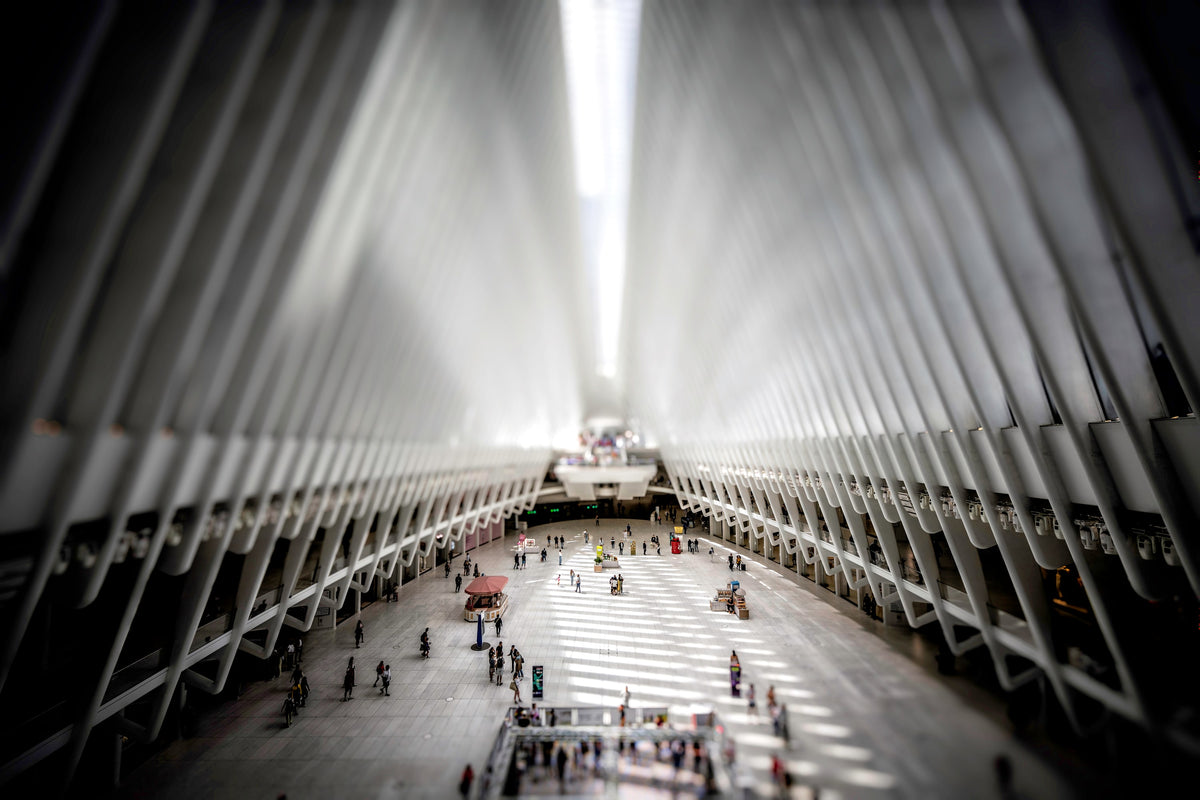
Enormous white steel ribs rise from either side of the central concourse, sweeping upward toward a narrow skylight that runs along the length of the building. The architecture feels almost skeletal, as though you're standing inside some enormous prehistoric creature or a futuristic cathedral.
It's unlike anything else in New York.
What immediately drew me to this composition was the extraordinary symmetry. The repeating structural elements create powerful leading lines, drawing the eye toward a distant vanishing point, while the people scattered across the concourse provide a wonderful sense of scale.
And then there's the light.
Sunlight streaming through the structure creates alternating bands of illumination and shadow across the floor. These patterns become an extension of the architecture itself, changing throughout the day as the sun moves across the Manhattan skyline.
As a photographer, I wanted to experiment with how we perceive the scale of this enormous space. The selective focus in this photograph creates an effect reminiscent of tilt-shift photography, keeping a narrow portion of the scene relatively sharp while allowing the foreground and upper architecture to gradually dissolve into softness.
The effect is rather intriguing.
The people below begin to resemble miniature figures, almost as though someone had constructed an elaborate architectural model and carefully placed tiny inhabitants throughout it. The enormous steel ribs, meanwhile, seem to stretch endlessly upward, disappearing into the soft light above.
I particularly enjoy how this treatment transforms an otherwise conventional architectural photograph into something slightly surreal. The building is real, the people are real, yet the photograph plays a little trick on our perception of both.
Photography doesn't always have to faithfully reproduce what stands before the camera. Sometimes, introducing a little abstraction encourages us to look at a familiar subject in an entirely different way.
Beyond its architectural beauty, however, the Oculus carries a significance that is difficult to separate from its location.
Having grown up on Long Island, I find it impossible to visit the World Trade Center without reflecting on the history of this particular piece of Manhattan. There is something deeply moving about the decision to create a space filled with natural light, openness, and upward-reaching forms in a place that has experienced such profound loss.
Calatrava could have designed a perfectly functional transportation hub. Instead, he created something that encourages people to stop, look upward, and marvel at their surroundings.
Quite an accomplishment in a city where everyone seems to be in a hurry.
Looking at this photograph, I'm struck by how the architecture seems to lift away from the earth, its enormous white ribs reaching toward the light while the little figures below continue about their daily lives.
Perhaps that's what makes the Oculus so appropriate for this particular corner of New York. Beneath its wings, life goes on.
And above them, there is always light.
Print details
Each piece is made to order in your selected finish:
- Framed: A professional lustre photo print in a slim matte black frame with standard acrylic and a wire wall hanger. The 12×18 size has a 1.5-inch double white mat; larger sizes have a 2-inch double white mat.
- Metal: A white high-gloss metal print with a 3/4-inch float mount.
- Gallery Wrap: Premium fine-art canvas with black edges, semi-gloss protective laminate, and sawtooth hangers with backing. Standard sizes have a 1 1/2-inch depth; the 40×60 size, where offered, has a 2 1/2-inch depth.
Framed Art Dimensions
| Print Size | Finished Framed Size |
|---|---|
| 12" × 18" | 13 1/8" × 19 1/8" |
| 16" × 24" | 17 1/8" × 25 1/8" |
| 24" × 36" | 25 1/8" × 37 1/8" |
Finished dimensions include the frame and represent the overall size of the piece.
Custom Sizes & Formats
Looking for a custom size or a different finish to complement your space? I’d be happy to explore additional options with you. Simply reach out using the Send a Message link in the website footer.
Shipping & returns
Each order is custom printed and finished to your specifications and typically ships within 3–5 business days. Because every piece is made especially for you, we cannot accept returns.
If your artwork arrives damaged, please contact me so we can arrange a replacement piece.


